

How to Select an Industrial Parts Cleaning System: A Complete Decision Process from Material, Contamination, Cycle Time to Cleanliness Verification

Selecting an industrial parts cleaning system is not only about machine size or cleaning method. The right choice depends on part material, contaminant type, cleanliness target, cycle time, filtration accuracy, drying requirement, and verification method. A reliable process starts with the part and contamination, then confirms the combination of spray cleaning, ultrasonic cleaning, high-pressure deburring, rinsing, filtration, and drying through sample testing.
Applicable Scenarios
Industrial parts cleaning systems are widely used for automotive powertrain parts, new energy vehicle components, hydraulic valve blocks, die-cast parts, precision machined parts, aerospace components, electronic structural parts, and high-precision metal parts.
Typical applications include engine blocks, cylinder heads, transmission housings, motor housings, battery trays, reducer gears, valve bodies, pump housings, aluminum die-cast parts, stainless steel precision parts, and machined parts with complex internal cavities. The key question is not simply whether the part can be cleaned, but whether it can be cleaned, rinsed, dried, and verified consistently within the required cycle time.
Not Suitable or High-Risk Scenarios
If the part material is sensitive to water-based chemicals, the geometry includes blind holes or deep cavities, the contamination is carbonized or strongly bonded, or the contaminant composition is unclear, a standard machine selection is risky. Contaminant analysis, material compatibility testing, and sample cleaning trials should be completed first.
For hydraulic, fuel, electric drive, or electronic cooling components with strict cleanliness requirements, experience-based parameters are not enough. The extraction method, particle limits, inspection standard, and packaging environment must be defined before finalizing the equipment concept.
Typical Parts and Typical Contaminants
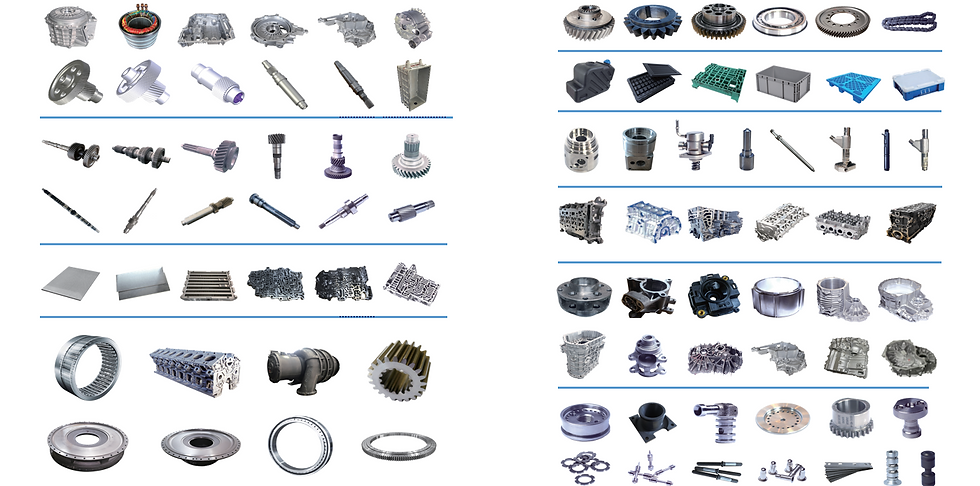
Typical parts include aluminum motor housings, transmission housings, hydraulic valve blocks, injector components, brake system parts, bearing seats, gears, shafts, compressor components, heat exchanger parts, and precision stainless steel connectors.
Typical contaminants include chips, grinding dust, machining oil, emulsion, particles, burrs, residual coolant, release agent, shot blasting dust, oxides, welding residue, sealant residue, and rust preventive oil. Each contaminant requires a different process logic: oil requires chemistry, temperature, and rinsing control; particles require flow, filtration, and cavity access; burrs and strongly attached particles may require high-pressure deburring.
Process Selection
Spray cleaning is suitable for external surfaces and open structures, with the result depending on pressure, flow rate, nozzle angle, and fixture positioning. Ultrasonic cleaning is useful for fine particles, small gaps, and complex surfaces, but it is not always the best choice for large thick-walled parts or mechanically attached burrs.
High-pressure deburring is suitable for cross holes, oil channels, hydraulic valve bores, and machined edges, but pressure, nozzle distance, and positioning accuracy must be controlled to avoid surface damage. Immersion cleaning is useful for complex cavities and parts that require full wetting, often combined with oscillation, rotation, or directed flow.
Rinsing reduces chemical and ionic residues and may require multi-stage rinsing or controlled water circulation. Drying should be selected according to geometry: hot air, compressed air, vacuum drying, or spin drying. For deep holes and blind cavities, vacuum drying or directed blow-off is often more reliable than hot air alone.
Key Parameters
Key parameters include part material, maximum dimensions, weight, hole and channel geometry, contaminant type, cleanliness limit, cycle time per part, annual output, loading method, cleaning chemistry, bath temperature, spray pressure, system flow rate, filtration accuracy, number of rinsing stages, drying method, and automation interface.
Filtration accuracy should not be selected in isolation. Coarse filtration, bag filtration, fine filtration, magnetic separation, oil-water separation, and online particle control must match the contaminant source. For high-cleanliness parts, filtration affects not only cleaning performance but also bath life, maintenance frequency, and inspection stability.
Cycle time should include loading, positioning, cleaning, rinsing, blow-off, drying, cooling, unloading, and sampling. Automated lines also need to consider robots, conveyors, MES connection, barcode traceability, and safety interlocks.
Cleanliness Verification
Cleanliness verification usually includes sampling definition, extraction method, membrane filtration, particle analysis, gravimetric testing, microscopic analysis, and reporting. In automotive and hydraulic applications, ISO 16232 and VDA 19 are commonly referenced when defining functional surfaces, internal cavities, and fluid channels.
Verification should be defined before equipment selection, not after delivery. During RFQ, it is advisable to specify particle size distribution, maximum particle size, total particle count, residual weight, test medium, extraction pressure, extraction time, and acceptance frequency. This ensures that process trials, FAT, and SAT use the same acceptance logic.
GRT Solution Perspective
GRT typically starts with drawings, material, contaminant information, production cycle time, and cleanliness requirements before recommending a standalone machine, flexible cleaning cell, or automated cleaning line. For complex projects, GRT uses sample testing to verify the right combination of spray cleaning, ultrasonic cleaning, high-pressure deburring, rinsing, filtration, and drying.
For European and North American projects, cleaning performance is only one part of the decision. CE compliance, safety protection, automation interfaces, project documentation, FAT/SAT, spare parts, and remote service support also matter. A sound selection is not the machine with the most functions, but the system that balances cleanliness, cycle time, maintainability, and total cost of ownership.
Case
A European new energy vehicle component project required cleaning of aluminum motor housings. The main contaminants were machining chips, emulsion, fine particles, and residual liquid in blind holes. The customer’s previous process cleaned external surfaces, but internal particle results fluctuated and residual liquid occasionally remained after drying.
After evaluation, the solution combined directed spray cleaning, local high-pressure flushing, multi-stage rinsing, fine filtration, and directed hot air with vacuum-assisted drying.
During sample testing, particle inspection and residual liquid checks were performed, and nozzle angles, fixture positioning, and filtration settings were adjusted according to the results.
The final solution focused on internal cavity particle removal and blind-hole drying stability, giving the customer a clearer basis for FAT and later site acceptance.
FAQ
1. What is the first step in selecting an industrial cleaning system?Start with the part, contamination, and cleanliness target. The machine type should follow the process requirement.
2. Is spray cleaning better than ultrasonic cleaning?Neither is universally better. Spray cleaning is strong for flushing and external surfaces; ultrasonic cleaning is useful for fine particles and complex surfaces. Many projects require both.
3. Is higher filtration accuracy always better?No. Filtration accuracy must match particle size, flow rate, maintenance cost, and cleanliness requirement. Excessively fine filtration may increase clogging and operating cost.
4. Can high-pressure deburring damage parts?Yes, if pressure, nozzle distance, angle, or positioning is incorrect. Sample testing is necessary before finalizing the process.
5. How should the drying method be selected?Open structures may use hot air or compressed air. Deep holes and blind cavities often require directed blow-off, rotation, or vacuum drying.
6. When should cleanliness verification be defined?It should be defined during RFQ and process testing. Otherwise, acceptance criteria may become unclear during equipment validation.
7. Is an automated cleaning line always better than a standalone machine?Not always. Automation is suitable for high volume, stable cycle time, and traceability needs. Flexible cells may be better for high-mix, low-volume production.
CTA
If you are evaluating an industrial parts cleaning system, prepare part drawings, material information, contaminant details, cleanliness requirements, production cycle time, and loading method. GRT can use this information to provide process evaluation, sample testing recommendations, and cleaning system selection support.

Comments